
From WPC 2023
From WPC 2023
Martin’s report
Martin Cowell
Good old BA - late again, but OK once our flight escaped Heathrow’s clutches. Then our taxi awaited us, so we were able to make it to our (Italian! Wot - in Spain?!) restaurant for dinner, a gentle walk from our oceanfront (well you could see the Mediterranean) hotel. ‘We’ were five members of PUK Oxford (Sally & Jonathan, Paul M-A and Julie, myself) plus colleagues from Reading and Amersham/High Wycombe branches.
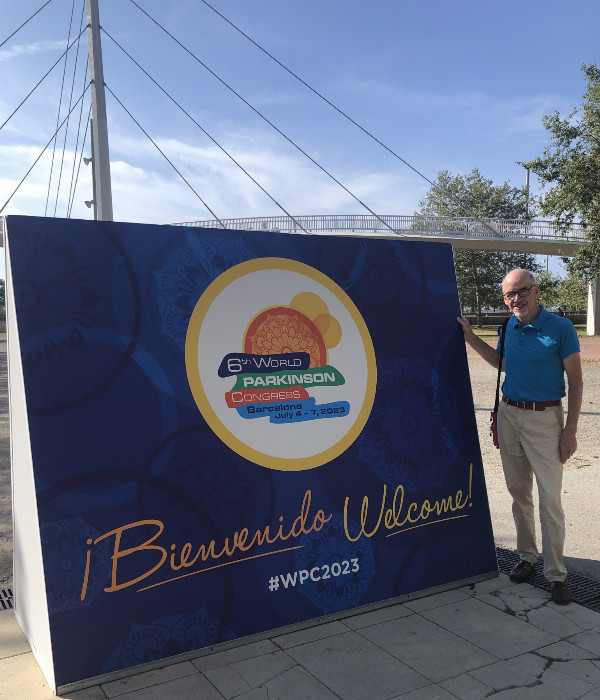
…with a gentle stroll to the spacious modern Convention Centre. Today featured the ‘Pre-Congress Program’ (WPC is based in Montreal and they spell differently there). There were six ‘Courses’: I chose ‘Fundamentals of Parkinson’s: The Journey’ which looked the most accessible to a non-scientist. We heard that over 2600 delegates from 73 countries were here, with just over half professionals, and the rest PwPs and ‘care-givers’.
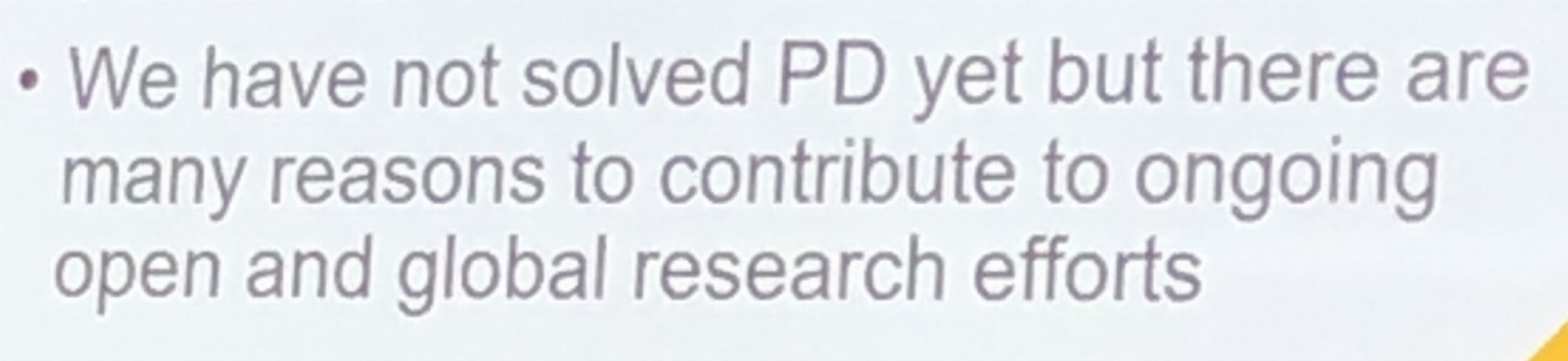
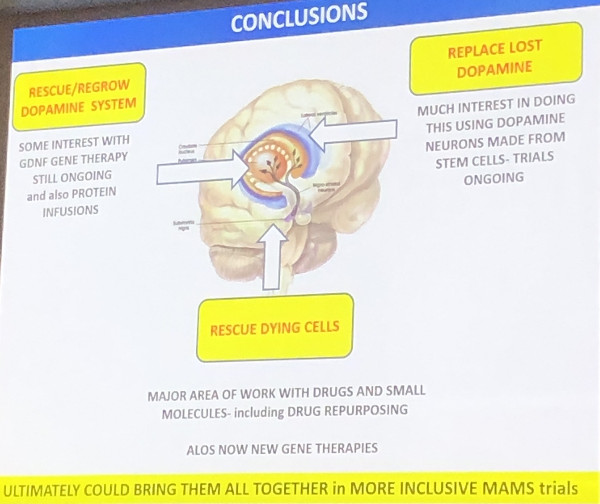
An impressive line-up of what were obviously eminent people took us through Clinical Features, Evolving Medical & Surgical Treatments, New Research, and New Treatments on the Horizon. This last from was Roger Barker from Addenbrookes in Cambridge, who later led the impressive Opening Ceremony, in his role as WPC Vice-President: his combination of clear scientific eminence and relaxed ‘bloke in the pub’ approach made for easy listening. He focused on work to ‘Rescue/Regrow Dopamine System’, ‘Replace Lost Dopamine’ and ‘Rescue Dying Cells’, with much mention of Stem Cells and Gene Therapy.
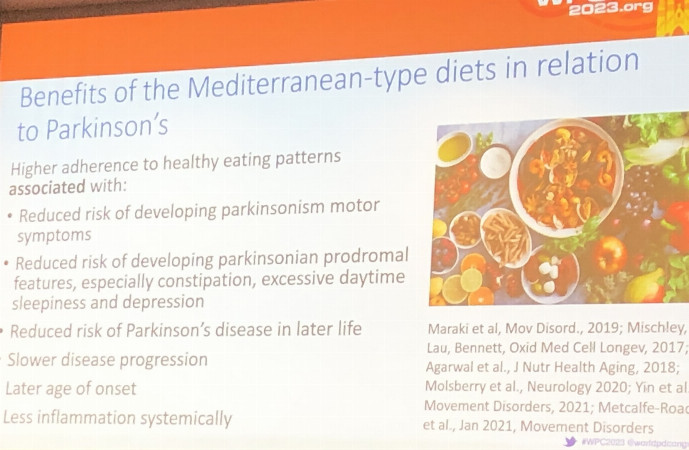
To keep us moving there were two exercise breaks - the first from an American professional dancer and Parkinson’s Movement Coach, a PwP for over 25 years; the second, in very different Barcelona style, from a young local neurophysiotherapist: both great fun! The morning ended with ‘Before we eat Lunch: what about nutrition?’ a lively and colourful presentation from a Canadian movement disorders consultant, with particular emphasis, appropriately, on the Mediterranean diet.
I tried other afternoon sessions : one including the advocate Matt Eagles, diagnosed on his 7th birthday. Another from the Parkinson’s Technology Community, who are trying to collate information on all the many (and growing) devices and applications (a UK questioner from the floor asked how they might address the determinedly-different approaches of the technology companies, meaning that the various sources of data could not be collated, with NIHCE having to make choices as to which to approve).
The Opening Ceremony was an inspirational event showcasing the power of the human spirit and the resilience of the Parkinson’s community with stories of care partners, people with Parkinson’s, and health professionals.
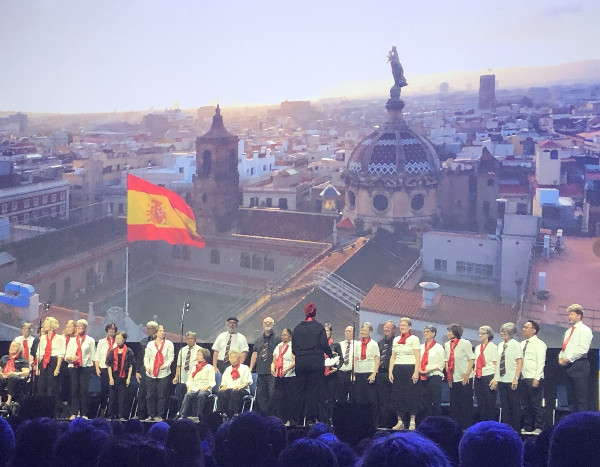
The evening opened with a special performance by the WPC Choir, led by WPC Choir Director, Judi Spencer and WPC Assistant Choir Director, Penny Stone. The choir sang the "The Road", written by Janet Shipton, Parkinson’s Advocate, from the UK.
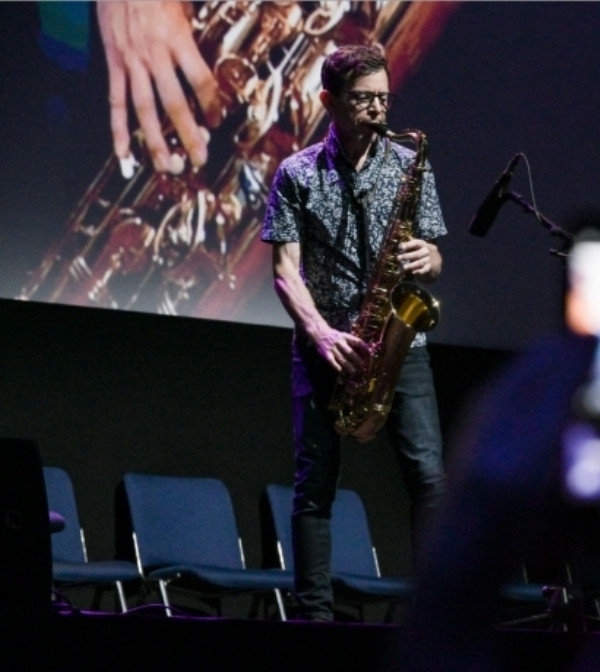
Later, attendees were serenaded by the music of Tomas Gisby, Parkinson’s Advocate from the UK who played his original music on the saxophone, accompanied by his own musical performance on five other instruments.
More than 30 dancers then performed Red, Yellow, Black choreographed by professional dancer and Parkinson Advocate, Pamela Quinn, showcasing the power of movement and importance of exercise on well-being. An emotional Keynote address from Connie Carpenter Phinney, a former world-class speed skater and Olympic cyclist, ended with everyone linking hands and raising their arms in mutual support.
Winners in the Congress video competition were warmly received: ‘Slim Shaky’, a clever ‘rap’ featuring his PwP mother by Sequoia (sic!) Lowe from Connecticut, won the main prize (watch on YouTube). The finale though took top honours: Parky Raccoon, a creative riff by Eli Schwarzschild on Rocky Raccoon by Lennon and McCartney (watch on YouTube) was accompanied by a clip from Sir Paul himself who, after welcoming us to WPC, spoke movingly of a childhood friend who had introduced him to John but then had succumbed to early-onset PD. Credit for this little coup, I learned later, was due to Richard Wyse, of Cure Parkinson’s, who had apparently seen Sir Paul sitting alone (though surely not in the public spaces?!) at Heathrow and approached him!
So the Congress itself starts, and Kevin [McFarthing, OxPUK Research Officer] is straight in at the deep end as Co-Moderator of the first Plenary session ‘Do biological subtypes of PD exist?’. There were four presentations: the first three of varying levels of scientific depth, with the last seriously over-running as it epitomised Germanic thoroughness - only for our spirits to be raised up by the wonderful and deeply personal final piece (‘What do subtypes mean for people with Parkinson’s?’) from Jonny Acheson, a Consultant in Emergency Medicine at Leicester, diagnosed in 2016. He received a well-deserved standing ovation for his talk, wrapped around his love of architecture, and Gaudi’s La Sagrada Familia in particular (and see below*). He won over the audience with his opening words when he took a picture of the audience to show his children who had wanted to know how many people he would be speaking to!!
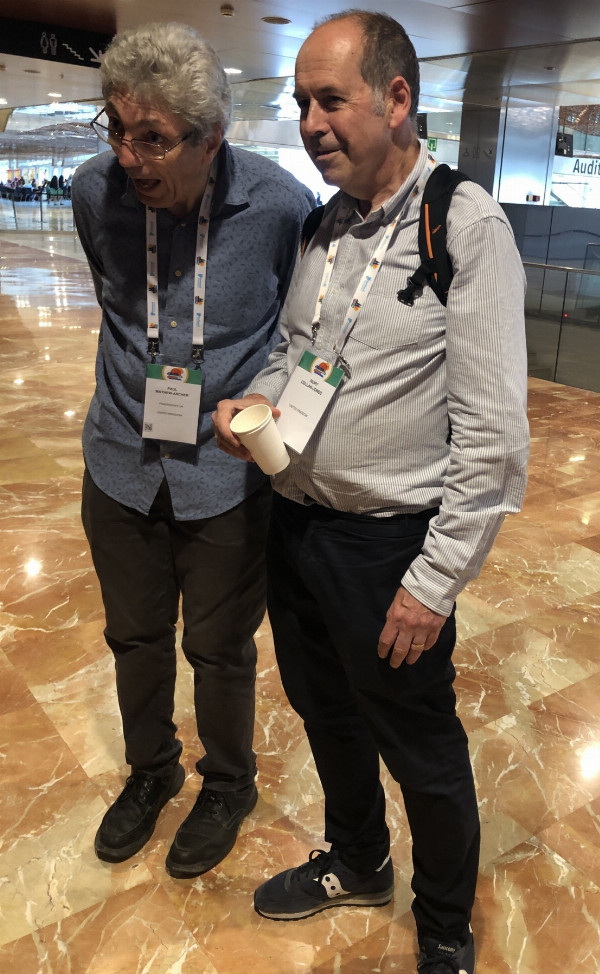
Then it was time to collect lunch (everyone has their own picnic bag). As I was looking for the pick-up point I bumped into Paul M-A and Rory Cellan-Jones.
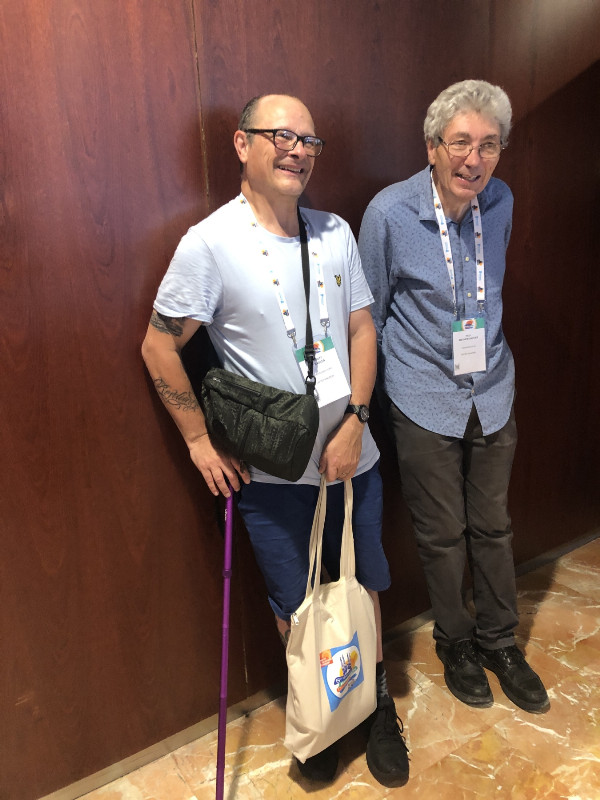
As we got off the escalator we passed Matt Eagles, and Rory immediately snapped him and Paul, before a discussion of the levels of anxiety generated by supporting Brentford, West Ham, Notts Forest and OUFC.
And so off to meet up again at the Book Nook with Ray Dorsey (we had touched base at last night’s Reception), co-author of ‘Ending Parkinson’s’ - and who had also come to the Cowell kitchen last year to be interviewed as part of the filming of the documentary on Guy Deacon’s African journey from Sierra Leone to Cape Town, highlighting the need for better Parkinson’s awareness. Ray (who must be nearly seven feet tall!) had also taken part in our hugely-successful webinar during lockdown to talk about the book, and I was delighted to find that with him was his co-presenter, the marvellous Bas Bloem (another giant!) managing to glad-hand everyone whilst munching his tuna sandwich!
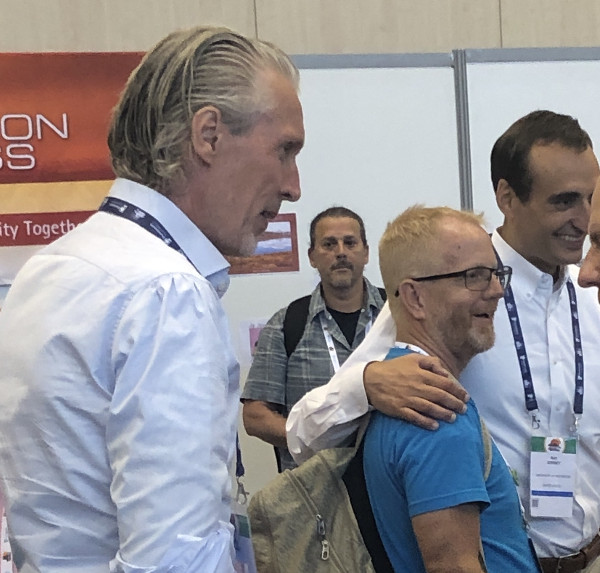
I managed to grab a couple of minutes to say ‘hello’ and thank him once more for supporting us. Then who else should be there but Joy Milne (‘the woman who can smell Parkinson’s’) who of course addressed the Branch earlier this year: I was also able to thank her personally too.
My amazing burst of name-spotting continued as I then spied Michael Lacey–Solymar, husband of Gillian of ‘Movers and Shakers’ fame, to whom I chatted briefly, before rushing off to my next destination*. By further pure chance I then found myself next to Gillian, who was on the same mission: in no time we had established that she is a Botley native: her 93-y-o father, who still lives there, is Emeritus Professor of Applied Electromagnetism at Oxford. I recalled selling his magnum opus ‘Electrical Properties of Materials’ (now I see in its 10th edition) in my time at OUP.
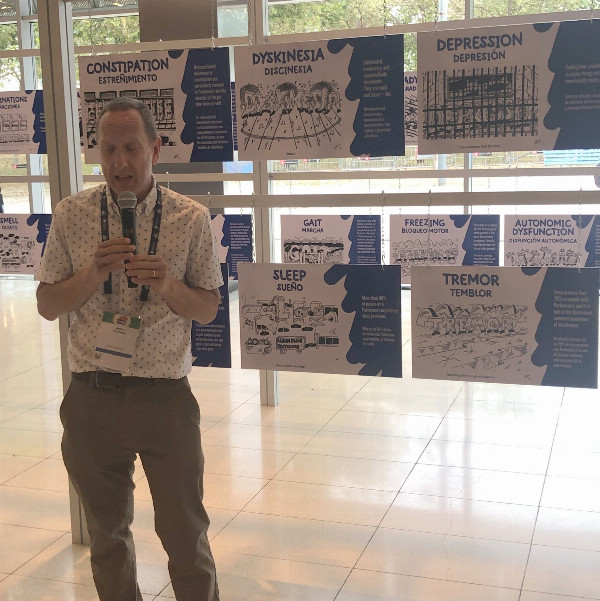
So where were we headed. Well the aforementioned *Jonny Acheson’s artistic interests extend to having created a whole series of line drawings of the letters that spell the symptoms of Parkinson’s - all of them on display here, with Spanish wordings by WPC. He talked through how the whole project had come about, and how his well-being had been so enhanced by doing it Afterwards I asked him if he knew Geoff Woodruff (he does) and then moved on to ask if he might be willing to come and give his talk - and maybe show and talk about his art - to the Branch: I am delighted to say that he is very willing to do so! Still the fun did not stop: I grabbed a seat at one of the communal lobby tables and found myself in conversation with some Americans from California, who are part of the Orange County Tremble Clefs (geddit??!!): ‘therapeutic singing for PwPs’!
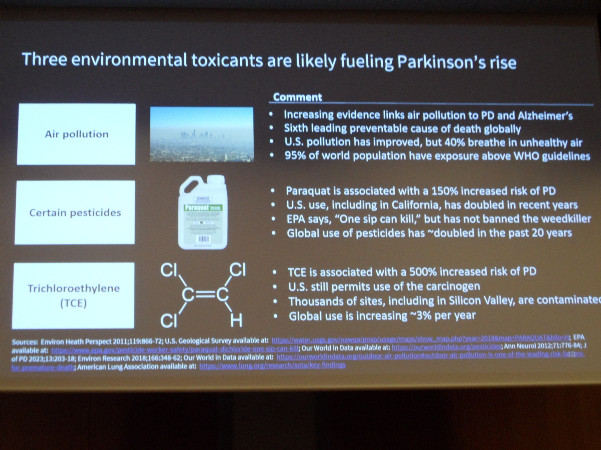
My first afternoon session was more from Ray Dorsey who completed a trio of presentations on ‘Environmental Contributions to PD’ (essentially his contribution to the book), the whole co-moderated by Michael Okun, another of his co-authors. The evidence of the links between pesticides and chemical toxicants to Parkinson’s seem incontrovertible - but there is no sign yet of any diminution in their global use - the opposite in fact.
A later session on ‘Novel Insights in the Therapeutic Benefits of Exercise-Related Interventions’ was on safer ground.
So to dinner… we were very pleased to have Caroline Rassell, with Gary Shaughnessy and his wife Janet, from Parkinson’s UK join us as our guests for dinner at Can Fisher, an excellent seafood restaurant on the beach.
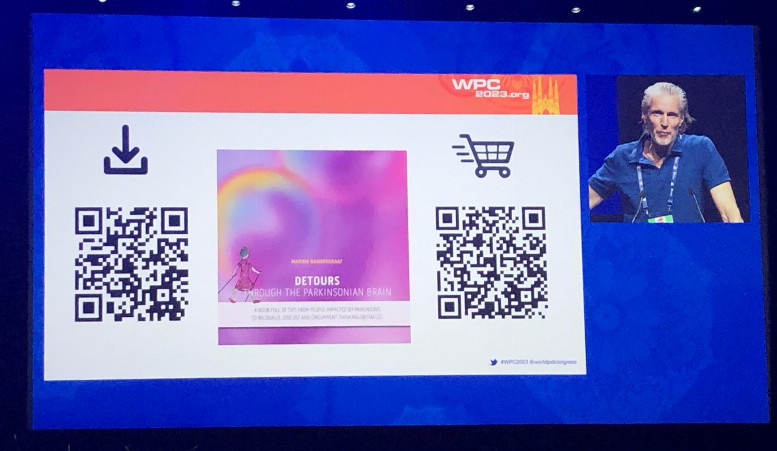
Today’s plenary session was all about tracking PD and Biomarkers, with Bas Bloem one of the keynote speakers - which meant the hall was packed He really is a rock star, as well as a genuinely nice guy. He emphasised once more how personalising has to be the way forward, highlighting again how often he saw his PwPs performing much better in the clinic than is obviously the case anywhere else.
David Standaert, a senior neurologist from Birmingham Alabama (other speakers also came from here - clearly a ‘centre of excellence) spoke eloquently and intelligibly on α-synuclein seed amplification assay (SAA) as a reliable identifier of people with PD. He was one of a number to mention the growing importance of skin biopsy, and also highlighted a recent Japanese paper on blood biopsy. He underlined that there is much important work going on - but we are not there yet!
Thilo van Eimeren from Cologne calmly overcame the fact that his slides would not show (‘nearly a session on imaging, without any images’!) to return to the podium later than scheduled.
Sara Riggare from Uppsala, Sweden, had been diagnosed at age 13, forty years ago, and was another to testimony from deep personal experience. She decided to dedicate herself to self-tracking as a way of best managing her symptoms (‘I spend one hour per year in neurological health care, and thus 8755 hours in self-care..’). Everyone tuned in to her mention of trying to decide whether a particular experience was a symptom? Was it PD-related or something else? Bas Bloem led the long applause when the moderator announced that Sara had recently been awarded her PhD.
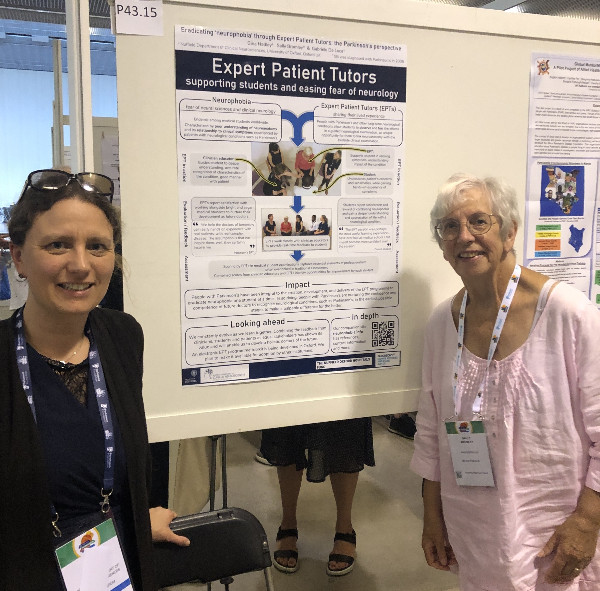
That evening, it was an honour to see Sally, and Gina Hadley, and their poster (one of a great many - but selected as one of the top 15%).
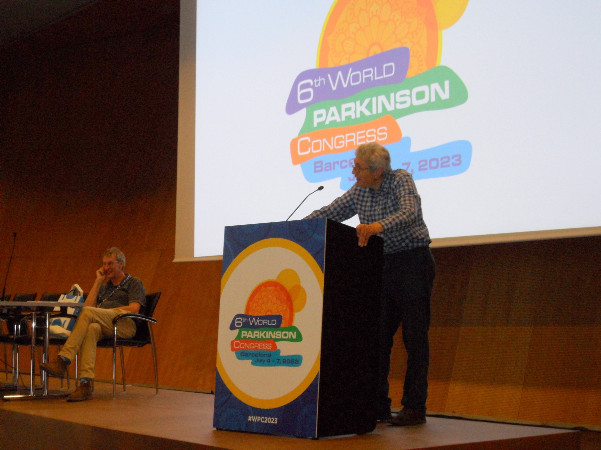
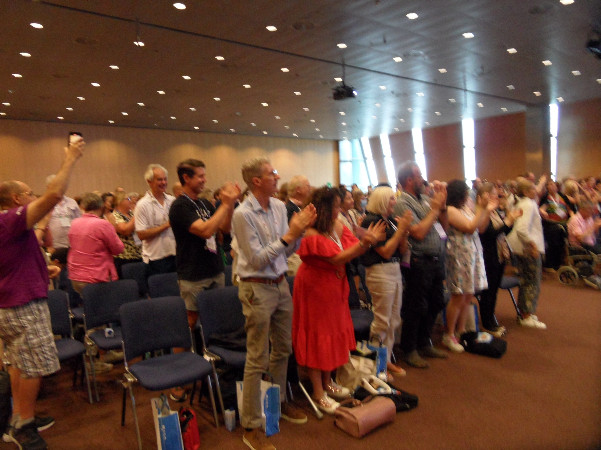
…was Paul’s show, given his documentary title of ‘Parkinson’s: The Funny Side’. Any concerns about how many people would turn up were quickly dispelled when the original large room filled to overflowing - and we all de-camped to somewhere more capacious. As Roger Barker said when ‘introducing’ Paul, this was clearly not necessary, given the number of people, keen to be there. Another PMA towering performance had the tears of laughter flowing!
This was a slickly-organised and well-managed programme with plenty for everyone at all levels and at every stage of the journey. It was a great venue, and the opportunity to meet everyone you could wish to in the Parkie world was one I was very pleased to have taken up. Thilo van Emmeren commented that he had never known a Conference with such energy - an accolade indeed.
Barcelona showed all its many talents: a proud thriving city, kept spotless by the highly-efficient management of its local services (‘one of the European cities with the highest number of rubbish bins per inhabitant: 25,229 in total’ : and everyone uses them!) and the army of workers in their dayglo yellow and green uniforms, proudly worn.